
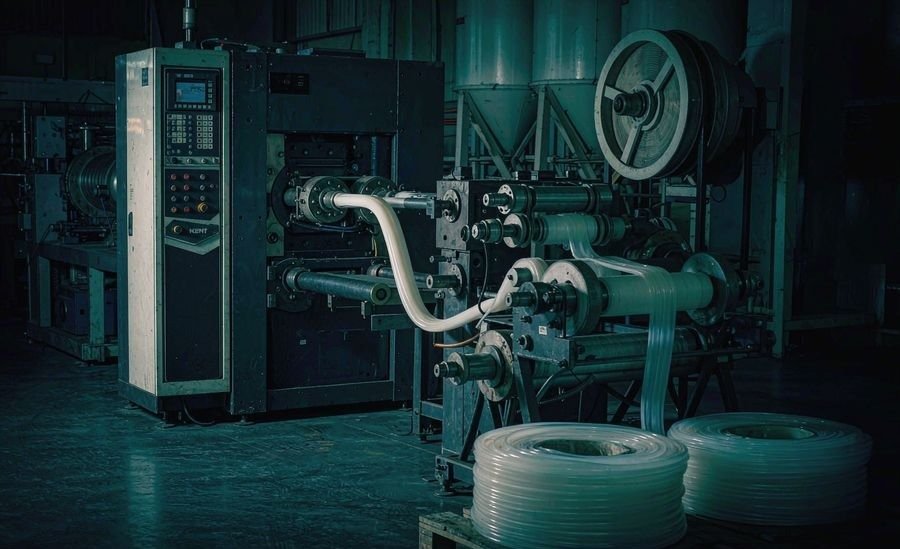
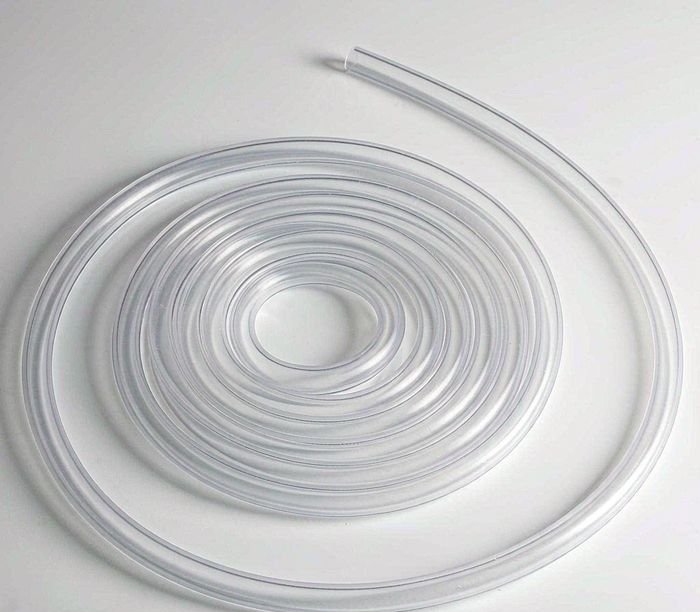
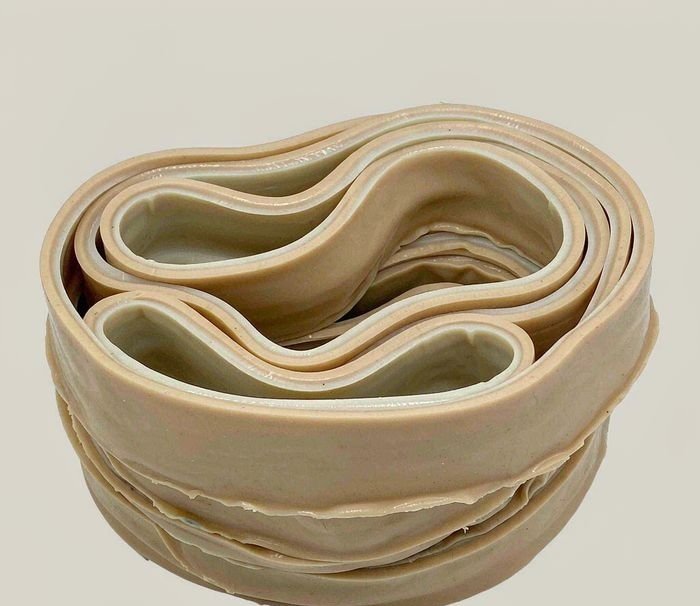
ID, wall and concentricity are three separate promises. Confusing them is the most common reason a tube that “meets drawing” still leaks on the filling line.
A silicone tube is a spring and a hose at the same time. Wall thickness sets how much it resists collapsing under vacuum, how much force a barb needs, and how quickly a peristaltic pump fatigues it. Past a point, more wall just makes the part stiff and expensive.
Most disputes come from treating these as one tolerance. They are measured differently and they fail differently.
| Dimension | Commercial | Precision | What drives it |
|---|---|---|---|
| Inside diameter | ±0.15 mm | ±0.08 mm | Mandrel size and draw speed |
| Wall thickness | ±0.15 mm | ±0.10 mm | Die gap and extrusion pressure |
| Concentricity | 0.20 mm TIR | 0.10 mm TIR | Mandrel centring in the die |
| Length | ±1.0 mm | ±0.5 mm | Cut method and cooling |
Take a 6.0 mm ID × 1.5 mm wall tube mated to a 6.0 mm barb. At commercial tolerance the ID can sit at 6.15 mm — that is already 2.5%% loose before the barb tolerance is considered. Add a soft 50 Shore A compound and the joint will weep under 1 bar.
The fix is rarely a tighter tube. It is usually a slightly undersized ID callout (−0.05 mm) so the interference is always positive.
Both are silicone rubber, and on a drawing they look identical. The cure system decides what leaches out of the …
28 Oct 2026 · 7 min read
Three names that get used interchangeably in quotation emails, and three completely different tests. Here is wha…
14 Oct 2026 · 9 min read
Two tubes, same ID, same wall, 12% different flow rate. The variable was hardness — and it is usually the last t…
07 Oct 2026 · 6 min read
Send a drawing or a sample. We will tell you which compound and hardness we would run, and what it costs at your volume.